IBM · IBM Generative AI & RAG Engineering Track
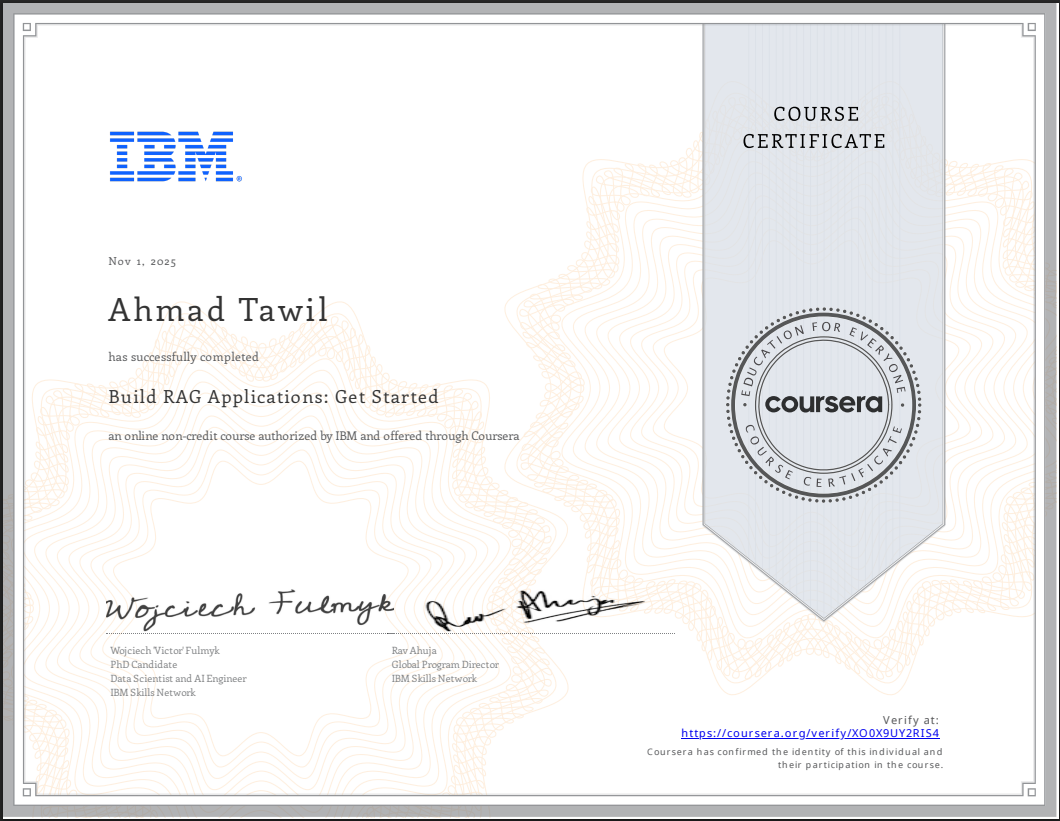
Build RAG Applications: Get Started
Retrieval-augmented generation pipelines with LangChain and LlamaIndex, integrating IBM Granite 3.0 models.
Completed 2025-11-01
🎓 IBM Generative AI & RAG Engineering Track
Course: Build RAG Applications: Get Started
Status: ✅ Completed
Instructor: IBM AI Engineering Team
Credential: Verified Certificate – 2025
📘 Overview #
This course provides a hands-on introduction to Retrieval-Augmented Generation (RAG) — an AI framework that combines retrieval and generation to produce context-aware, accurate, and explainable LLM responses.
Across three progressive modules, I learned to:
- Build RAG pipelines using LangChain and LlamaIndex
- Integrate IBM Granite 3.0 large language models
- Design interactive AI applications with Gradio
- Compare different frameworks for retrieval and data ingestion
- Deploy end-to-end RAG solutions powered by Python + watsonx.ai
🧩 Course Structure #
| Module | Title | Framework | Focus | Status |
|---|---|---|---|---|
| 1 | What is RAG | LangChain | Fundamentals of retrieval, embeddings, and grounding LLMs in private data | ✅ Completed |
| 2 | Build Apps with RAG | LangChain + Gradio | Interactive RAG application (QA bot) using IBM Granite & local vector DBs | ✅ Completed |
| 3 | Build RAG Apps with LlamaIndex | LlamaIndex | Understanding indexing, retrieval, and query engines; comparison to LangChain | ✅ Theory Completed / Lab Skipped (Proxycurl deprecated) |
🎯 Learning Objectives #
By completing this course, I am able to:
- Explain how RAG improves LLM reliability, trust, and factual grounding
- Implement document ingestion, chunking, embedding, retrieval, and generation steps
- Design user-friendly interfaces for AI apps using Gradio
- Compare the design philosophies of LangChain (process-centric) and LlamaIndex (data-centric)
- Integrate enterprise-grade models like IBM Granite 3.0 into RAG workflows
🧠 Key Concepts & Architecture #
User Query
    ↓
Embed Query (Encoder)
    ↓
Retrieve Top-K Similar Chunks (Vector Store)
    ↓
Augment Query with Retrieved Context
    ↓
Generate Grounded Answer (LLM)
    ↓
Return Context-Aware Response to User
Core Components
| Stage | Component | Description |
|---|---|---|
| Ingestion | Document, SimpleDirectoryReader | Load and parse raw data from text/PDF/CSV/JSON |
| Chunking | SentenceSplitter, RecursiveCharacterTextSplitter | Split large documents into nodes/chunks |
| Embedding | VectorStoreIndex, FAISS/Chroma | Convert text into dense vectors for semantic search |
| Retrieval | Retriever | Find relevant document chunks based on query similarity |
| Generation | LLM (IBM Granite) | Produce natural-language output grounded in context |
| Interface | Gradio | Web-based user interface for input/output |
🧩 Module Summaries #
Module 1 – What is RAG #
- Learned how retrieval enhances LLM accuracy.
- Built a simple document summarization RAG pipeline with LangChain.
- Covered embeddings, similarity metrics, and vector databases (FAISS, Chroma).
📁 Module1_README.md
Module 2 – Build Apps with RAG #
- Designed an interactive QA application using Gradio + LangChain.
- Integrated IBM Granite 3 for grounded answers over uploaded PDFs.
- Demonstrated full workflow: load → split → embed → retrieve → generate → UI.
📁 Module2_Build_Apps_with_RAG_README.md
Module 3 – Build RAG Apps with LlamaIndex #
- Explored LlamaIndex concepts: Document ingestion,
VectorStoreIndex, andQueryEngine. - Compared LangChain vs LlamaIndex (process- vs data-centric design).
- Understood SentenceSplitter, ResponseSynthesizer, and QueryEngine automation.
- Note: The “AI Icebreaker Bot” lab was skipped due to deprecated Proxycurl API; however, the LlamaIndex theory and pipeline logic were fully mastered.
🚀 Outcomes #
By completing the course, I have:
- Built two end-to-end RAG pipelines (LangChain + Gradio).
- Learned to design, implement, and evaluate retrieval-grounded LLM apps.
- Gained practical knowledge in embedding models, vector databases, and LLM orchestration frameworks.
- Acquired a transferable workflow applicable to future Cloud, IoT, and Agentic AI projects.
🏗️ Repository Structure #
📁 Build_RAG_Applications_Get_Started/
│
├── image.png                           # Certificate
├── Module1_README.md                   # Module 1 summary
├── Module2_Build_Apps_with_RAG_README.md  # Module 2 summary
└── README.md                           # (this file)
🧭 Next Steps #
- Continue to “Build RAG Applications: Get Advanced” for hybrid retrieval and evaluation metrics.
- Re-implement a self-coded RAG pipeline using open-source LLMs (Llama 3 / Mistral) instead of watsonx.ai.
- Integrate RAG into the Cloud & IoT portfolio project for intelligent device data retrieval.
🏁 Key Takeaway #
RAG is not just a technique — it’s the foundation of modern, trustworthy AI systems.
Mastering both LangChain and LlamaIndex empowers developers to build scalable, explainable, and enterprise-ready generative AI applications.